Room
Lives and events
Dated events of particular people, ships or trains: when each began, moved and ended. The forms here show each one apart.
Studied from its original page 2
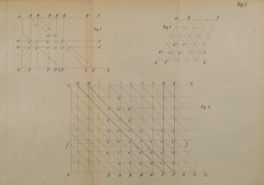
Lexis diagram
Wilhelm Lexis · 1875
Every life as a vertical line rising from its moment of birth: age runs up the page, and dates run as descending diagonals.
Concentric-occupation symbol with over/under chronology
Charles O. Paullin (Carnegie Institution of Washington and American Geographical Society of New York) · 1932
Catalogued 37
- Parapegma Meton of Athens with Euctemon · 432 BCE
- Houfeng didong yi (Zhang Heng seismoscope) Zhang Heng · 132
- Eusebian chronological canons Eusebius of Caesarea; Latin recension by Jerome · 325
- Joachim of Fiore figurae Joachim of Fiore; compiled posthumously · 1200
- Mixtec screenfold codex Mixtec scribes · 1300-1500
- Runic calendar staff (primstav) Norwegian folk-craft tradition; maker unknown · 1457
- Fasciculus temporum Werner Rolevinck · 1474
- Lakota winter count Lakota keepers · 18th-19th c.
- Floral clock (horologium florae) Carl Linnaeus · 1751
- Barbeu-Dubourg Chronographie Jacques Barbeu-Dubourg · 1753
- Floral calendar (Calendarium Florae) Carl Linnaeus and Alexander Malachias Berger · 1756
- Chart of Biography Joseph Priestley · 1765
- New Chart of History Joseph Priestley · 1769
- Itamat (Yakama time ball) Yakama and Plateau peoples · 1800s
- Lukasa memory board Luba (Congo) court historians · 19th-20th c.
- Stream of Time (Strom der Zeiten) Friedrich Strass · 1804
- Polish system of chronology Antoni Jażwiński; popularised by Józef Bem; E. Peabody · 1820s
- Train graph (time-distance diagram) Ibry (attrib.); popularised by Marey · 1840s/1878
- Temple of Time Emma Willard · 1846
- Mineral paragenesis chart August Breithaupt (concept); chart form conventional · 1849-1900s
- Leech barometer George Merryweather · 1850
- Adams Synchronological Chart Sebastian Cabot Adams · 1871
- Becker's time-and-moment-of-birth diagram Karl Becker · 1874
- Harmonogram Karol Adamiecki · 1896
- Cricket linear scoring John Atkinson Pendlington; developed by Bill Ferguson and Bill Frindall · 1900s
- Milestone chart No single originator documented · 20th century
- Peg-and-string scheduling board No originator documented; factory production control · 20th century
- Gantt chart family (progress, load, man and machine records) Henry L. Gantt · 1910s
- Two-handed process chart Frank Bunker Gilbreth and Lillian Moller Gilbreth · 1911-1921
- Man and machine record chart Henry Laurence Gantt · 1917-1922
- Life chart Adolf Meyer · 1919
- Signal progression time-space diagram US urban traffic signal practice; no single originator · 1920s
- SIMO chart Frank Bunker Gilbreth and Lillian Moller Gilbreth · 1921
- Multiple activity chart No single inventor documented; work-study practice · mid-20th century
- Synchronoptic world history Arno Peters · 1952
- Raster plot and peristimulus time histogram Neurophysiology practice; no single originator · 1960s
- Space-time aquarium Torsten Hägerstrand · 1970
Could also hang in: Lives and events 13
- Wampum belt Haudenosaunee (Iroquois) nations · 1142-1700s
- Matrakçı Nasuh itinerary views Matrakçı Nasuh · 1537
- Kupe tally bundle Torres Strait Islanders · 1800s
- Message stick Aboriginal Australian peoples, many language groups · pre-contact; documented from 1880s
- Mechanical teaching map James Ives · 1896
- Kardex visible record system James H. Rand Sr. (visible index); James Rand Jr. (Kardex brand) · 1898-1915
- Minkowski space-time diagram Hermann Minkowski · 1908
- Material control board Gantt-school production control practice · 1918-1939
- Focal mechanism (beachball) diagram Hidezo Nakano (method); Perry Byerly (teleseismic solutions) · 1923-1928
- Dowding system plotting table Hugh Dowding with Henry Tizard and Patrick Blackett · 1940
- Loedel diagram Enrique Loedel Palumbo · 1948
- Brehme diagram Robert W. Brehme · 1962
- Penrose (conformal) diagram Roger Penrose · 1963-1964