Studied from its original page
Area-proportional nested population square with external companion
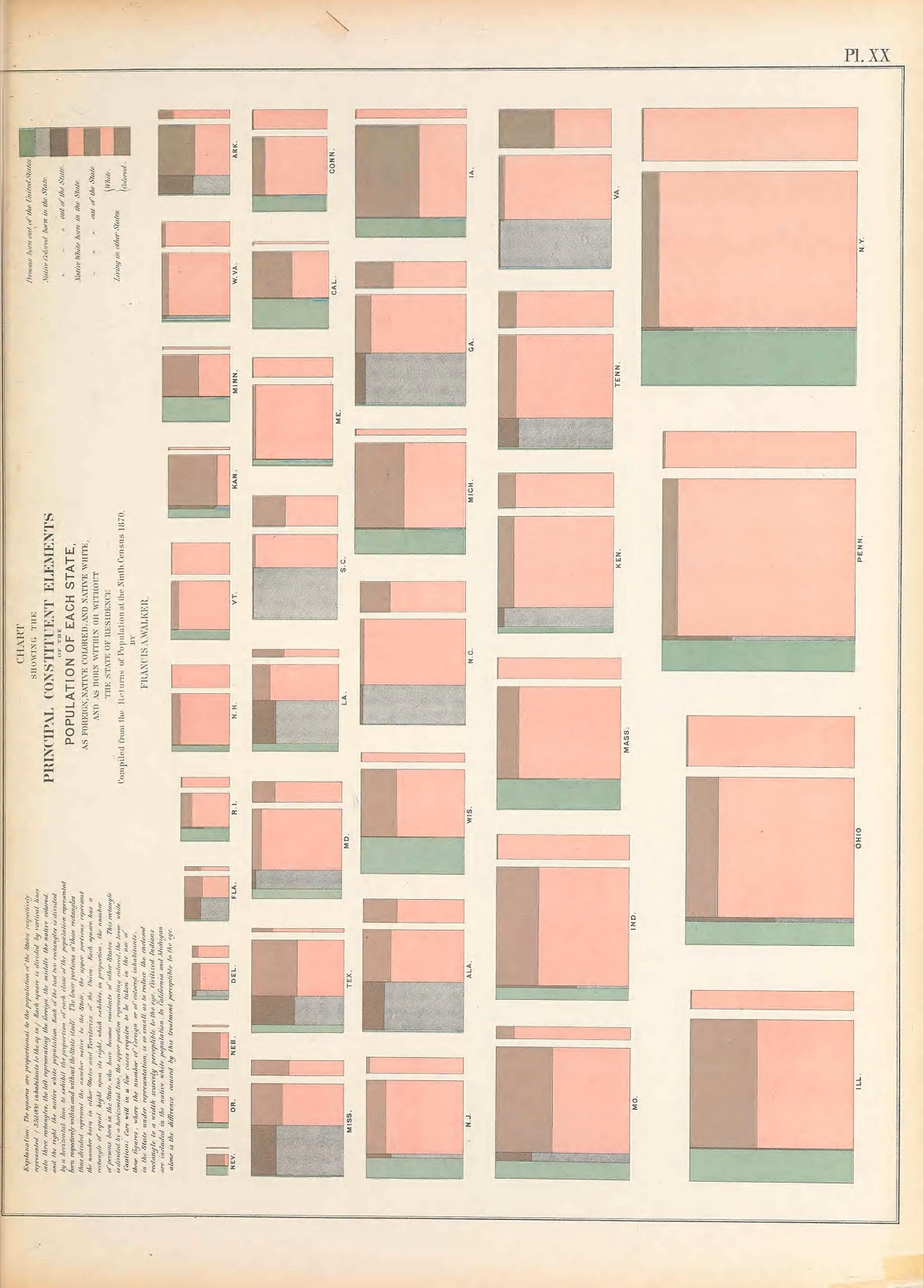
Chart showing the principal constituent elements of the population of each State (Pl. XX)
- Made by
- Francis A. Walker
- Year
- 1874
- Field
- Statistics
- Kind
- Data display
- Room
- Parts of a whole
What it shows
Each place's population as a square whose area is its size, cut into its parts, with a separate bar for those born there who live elsewhere.
How it is read
Compare squares by area for size, the widths inside for each part's share, and the outside bar against its own square.
See the original page — Pl. XX (archive leaf n100)
Published 1874 (A, and also a US federal work) and a government work with its compiler Walker dead since 1897 (B).
The data it needs
unitidentity · categoricalpartvertical split · categorical · 2-4 memberssubparthorizontal split (optional) · categorical · at most 2 per partcountarea · quantitative · personsexternalcompanion width at equal height · quantitative · personsexternal_partcompanion split (optional) · categorical
Built in 4 steps, as its maker described
Pl. XX; Missouri worked example, Preface p. 3 (archive leaf n12)
14 other forms share this skeleton
Source
Walker 1874, Statistical Atlas of the United States
Attribution checked against the source